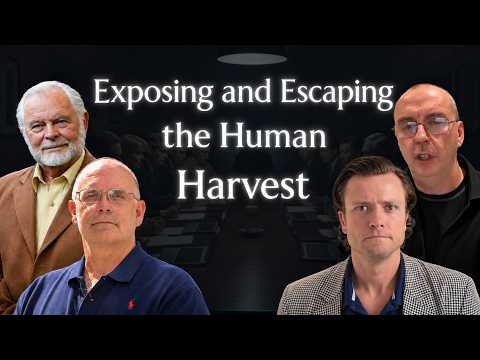
G. Edward Griffin, Feargus O'connor Greenwood, Dave Collum: Exposing And Escaping The Human Harvest
https://www.youtube.com/watch?v=7fTrkT6MFaQ
TLDR
The discussion ranges from how banks create money and the risks of economic bubbles to distrust of healthcare, politics, media, and digital control. The speakers share many unverified claims about medical harms, trafficking, spiritual forces, and political conspiracies, while urging people to question official narratives, organize around principles like liberty and privacy, and take practical action rather than wait for a savior.
Key Insights
Separate verified facts from interpretation
When evaluating claims about banking, healthcare, politics, or alleged hidden forces, distinguish documented evidence from personal testimony, speculation, and opinion. Check original records and seek independent confirmation before sharing a claim. The speakers themselves describe uncertainty and disagreement on several topics, which is a reminder not to treat every assertion in a conversation as established fact. Clear sourcing makes research more reliable and helps readers assess conclusions for themselves.
Build understanding from credible, varied sources
The conversation highlights how writers can learn from earlier research, compare perspectives, and explain complex subjects in accessible language. Read across multiple sources, note where they agree or differ, and credit the people whose work informed your conclusions. For important factual claims, prioritize primary documents and transparent, reputable analysis. Summarizing evidence in your own words can reveal gaps in your understanding before you publish.
Protect attention and make learning sustainable
Long-form reading and listening can help people work through complex ideas without relying only on headlines or social-media posts. Set aside focused time, reduce digital distractions, and use audiobooks during commutes or other routine activities if that suits your schedule. Keep notes on key claims and questions so that a compelling story does not become a substitute for verification. A steady learning routine is more useful than trying to absorb everything at once.
Assess health decisions with qualified guidance
Personal stories about medications or supplements can raise useful questions, but they cannot establish that a treatment is safe or effective. Before starting, stopping, or changing a medication, discuss the decision with a qualified healthcare professional who can consider your history and explain the evidence and risks. Ask for sources, alternatives, and a clear plan for follow-up, and seek a second opinion when concerns remain. Treat sweeping claims about drugs, vaccines, or natural remedies cautiously unless they are supported by strong evidence.
Turn concern into practical, local participation
The speakers argue that understanding problems is only a starting point and that people also need to contribute in communities and institutions. Choose a concrete, lawful activity—such as attending a local meeting, supporting a community group, contacting representatives, or sharing well-sourced information. Focus on principles and specific outcomes rather than assuming that one leader or election will solve complex problems. Consistent participation can make a difference without requiring everyone to agree on every issue.
Keep political disagreements grounded in shared principles
When discussing divisive subjects, avoid treating entire populations or political opponents as inherently evil. Focus on specific actions, evidence, and principles such as liberty, privacy, and accountability. Listen to people’s lived experiences, including those outside your usual information bubble, and be willing to revise your view when stronger evidence emerges. This approach supports more constructive debate and reduces the risk of replacing one form of coercion with another.
Questions & Answers
How did G. Edward Griffin’s *The Creature from Jekyll Island* gain popularity?
It initially spread through readers recommending it and small bookstores ordering copies. Larger distributors followed after demand became clear, and the book eventually reached roughly its 53rd printing.
How do banks create money, according to the discussion?
The speakers describe banks as creating money when they issue loans, rather than merely lending out money that already exists.
What do the speakers say about the economy and the risk of a crisis?
They believe the economy may be near a frothy market-cycle peak, with bubbles building on one another and a crisis potentially unfolding quickly and painfully. They compare the risk to a system pushed far from equilibrium and argue that smaller corrections may be less damaging than postponing a major collapse.
What concerns do the speakers raise about technology and digital authoritarianism?
They worry that AI and digital systems could reduce the need for human labor and make it easier for authorities to monitor and control people. They also note that technology can help like-minded people find one another.
What practical advice does Griffin give about a purely spiritual response to social problems?
Griffin says spiritual concerns should not become an excuse for inaction. He urges people to recognize their challenges and take practical steps, summed up by the saying, “Pray for potatoes, then reach for the hoe.”
What do the speakers say is needed for lasting political and social change?
They argue that change requires people to take responsibility and become influential in places such as politics, churches, media, and community organizations. They emphasize shared principles—such as liberty, privacy, and spiritual life—rather than simply trusting a leader or election to solve problems.
What is the central argument of Edward’s booklet *The Chasm*?
It presents collectivism versus individualism as the core ideological divide, rather than political labels such as left and right, communism, or fascism. Edward offered the booklet for free at chasm.realityzone.com and encouraged people to share and print it.
What recommendations and cautions do the speakers offer about health information?
They recommend looking beyond official sources, including patient reports and independent writers, but caution that anecdotal remedies and claims can be difficult to verify. They also argue that people need trustworthy health guidance and express concern about pharmaceutical influence and drug side effects.
What did the speakers say about audiobooks?
One speaker says audiobooks make it possible to finish about 20 books a year by listening during commutes and errands. He recommends keeping several audiobooks available for long drives, while the author says producing an audiobook can be a major undertaking and that there are no immediate plans for one.
Summary of Timestamps
Fergus O’Connell Greenwood describes the five- or six-year process behind his 800-page book *180 Degrees: Learn the Lies You’ve Been Taught to Believe*. He credits G. Edward Griffin with helping him explain how banks create money in a clear, concise way. The conversation also introduces Greenwood’s book *Spiritual War: Tales of the Unexpected, Part One*.
The guests discuss how *The Creature from Jekyll Island* grew from a book with modest initial advertising into a widely read title, thanks largely to reader recommendations and independent bookstores. They also mention Richard Werner’s experiment as evidence in the debate over how banks create money when they issue loans.
Greenwood explains that research and clear writing involve learning from earlier authors, checking one’s understanding, and crediting sources. The speakers describe writers as curators and distillers of ideas, and note that economic crises and inflation can renew public interest in books about money and banking.
The discussion broadens to economies that depend too heavily on one source of wealth, from Spain’s gold to modern financial instruments. The speakers worry that AI and digital systems could create a ‘digital poor’ era by reducing the need for human labor and sidelining broader human development.
The guests describe markets as increasingly unstable, with bubbles building on top of one another and a crisis potentially arriving quickly. They compare delayed economic adjustments to earthquakes or avalanches and debate whether a possible Federal Reserve leadership change could signal a major reset.
Dave Collum discusses writer’s block, concerns about his wife’s health, and uncertainty about completing his usual long annual review. He considers focusing on problems in healthcare, while Greenwood suggests spending time barefoot in nature as one possible way to find creative inspiration.
The conversation turns to healthcare information and the difficulty of identifying trustworthy sources. The speakers share concerns about pharmaceutical incentives and discuss their broader interest in claims of spiritual possession among powerful people, while presenting these as their interpretations rather than established facts.
The guests consider whether reports of unusual eyes, ‘zombies,’ and alien-like appearances might have spiritual or interdimensional explanations—or could relate to intelligence-agency programs and conditioning. They emphasize that the author’s book includes both MK Ultra-related accounts and experiences he believes fall outside that framework.
The author recounts accounts from Rachel War and his friend Abner, including claims of childhood ritual abuse and encounters with people whose eyes appeared completely black. He also describes a lunch with David Icke, where Icke said a man had vertical pupils, though the author could not see them himself.
The speakers reflect on how accounts of trafficking and abuse led them to use moral language such as ‘good and evil.’ They discuss how interviews and reading changed their views, and express concern that digital systems could enable authoritarian control without depending on a large military or police force.
The conversation examines digital authoritarianism, political persuasion, and the exhaustion caused by constant distractions and alleged ‘psyops.’ The guests also discuss health claims involving supplements, stressing that personal anecdotes can be difficult to evaluate and that people need reliable medical guidance.
The speakers criticize pharmaceutical marketing and discuss reports of difficult withdrawal from antidepressants, alongside concerns about statins and GLP-1 weight-loss drugs. They disagree about how broadly to generalize from personal experiences but share the view that the body is an interconnected system.
The guests debate whether doctors are uninformed, constrained by workplace and legal pressures, or sometimes unwilling to challenge medical protocols. They raise vaccine-related claims, disputes over polio history, and accounts of doctors who lost jobs for questioning COVID-era policies; these claims are discussed but not independently verified in the conversation.
The discussion shifts to how people can communicate challenges to official narratives, especially across generations. The speakers say younger people may dismiss unfamiliar ideas, but also note that more young attendees are arriving at meetings informed, engaged, and frustrated.
The guests argue that understanding the truth is not enough: people must also build influence in politics, media, churches, and community organizations. They discuss young people’s interest in long-form reading, the effects of digital distraction, and the idea that a relatively small committed group can help bring about change.
The speakers debate political mobilization, leadership, and rumors connected to Israel, Ukraine, and religious prophecy. They raise concerns about apocalyptic agendas and ask how to interpret Donald Trump’s actions and changing public image.
The guests disagree over whether Trump changed after entering politics or had always played a role based on disruption and chaos. One speaker offers an occult interpretation, while another recounts Trump’s early public image and speculates about his connections to powerful political interests.
The conversation considers constitutional principles, political handlers, and Trump’s decisions on Iran. One speaker argues that war and daily news can distract from a deeper strategy that creates economic scarcity and encourages people to exchange liberty for security; another regards this as an extreme interpretation.
The guests discuss why leaders seek power over larger territories, suggesting ambition, fear, and the search for meaning as possible motives. They also debate whether spiritual forces should be understood literally or metaphorically, before turning to books, quotations, and the growing popularity of audiobooks.
One speaker explains that audiobooks make it possible to finish many books during commutes and errands, and recommends keeping several titles available for long drives. He recalls an audiobook about the Bush White House that claimed the first Cabinet meeting focused on going to war with Iraq.
The speakers discuss the idea that ‘this is a spiritual war.’ Griffin agrees that spiritual forces may be involved but warns against using that belief as a reason for inaction. They endorse combining prayer with practical effort, summed up by the saying, ‘Pray for potatoes, then reach for the hoe.’
The guests caution against demonizing ordinary people in other countries or treating political opponents as inherently evil. They point to everyday life in Tehran as a reminder that people in different places often share familiar interests and experiences.
The speakers expect significant social, political, and economic hardship and argue that no single election or leader can solve everything. They emphasize principles such as liberty, privacy, and spiritual life, and introduce a planned book proposing a ‘universal constitution’ focused on principles rather than personalities.
The conversation closes with Edward’s booklet *The Chasm*, which presents collectivism versus individualism as a central ideological divide. Edward encourages listeners to download and share the free booklet; Greenwood discusses how its ideas informed *180*, and the guests share contact information before thanking the audience.
Related Summaries
 G. Edward Griffin, Feargus O'Connor Greenwood, Dave...
 I Analyzed 12.2M Cold Emails to Find the Perfect Em...
 How I Build $1,000,000 Offers Nobody Can Compete Wi...
 Structural Flows Will Support Stocks Until the U.S....
 Raoul Pal: The Economy We Know Ends by 2030 — and W...
 Wharton’s Top AI Professor: Stop Starting Softwar...