Summaries > Cryptocurrency > Bitcoin > Chamath: Bitcoin Goes to Zero, Robots vs. $40T Debt, Elon’s SpaceX Shares for 7...
Chamath: Bitcoin Goes To Zero, Robots Vs. $40 T Debt, Elon’S Space X Shares For 72 M Kids | Ep #304
https://www.youtube.com/watch?v=kAwG9E1W_ME
TLDR AI could transform wealth, work, and the economy, but its spread depends on scarce power, data centers, and compute—and its benefits will hinge on who owns and controls them. The panel explores public equity gifts, new approaches to taxation and philanthropy, AI safety and national debt, and opportunities in energy infrastructure and entrepreneurship, while warning that rapid change could deepen inequality and geopolitical dependence.
1. Treat AI infrastructure as a practical bottleneck
AI’s impact depends not only on model capability but also on access to electricity, data centers, skilled workers, cooling systems, and permits. Before investing in or building an AI project, check whether the required compute and power are actually available and when they can be delivered. Power shortages and construction delays may slow the spread of AI even when the technology is ready. For businesses, securing reliable compute and energy can be as important as choosing a model.
2. Look for opportunities across the energy and compute supply chain
The discussion points to power generation, batteries, data-center construction, cooling, and grid connections as potential areas of opportunity. Solar and wind were described as relatively inexpensive and quick to deploy, while nuclear projects may face lengthy permitting and local opposition. These are observations from the panel, not guarantees of investment returns. Evaluate each opportunity based on local regulations, project costs, financing, and the time needed to connect it to the grid.
3. Make AI adoption solve a real economic problem
More compute does not automatically create value; organizations still need useful applications that justify the cost. Start by identifying a specific task where AI could save time, improve service, or reduce expenses, then test whether the results are reliable enough for practical use. Compare the cost of models and infrastructure with measurable benefits, and account for privacy, security, and human review. Efficient, smaller models may be a better fit than the most powerful system for some jobs.
4. Build ownership and financial literacy alongside opportunity
The proposed share gifts to children illustrate how equity ownership could introduce young people to investing and long-term compounding. The panel also emphasized that a modest share transfer is a gesture, not a substitute for broader financial security. Families and educators can use stock ownership as a starting point to explain risk, diversification, company performance, and the difference between owning an asset and receiving cash. Any public-benefit or share-gifting plan should also explain who controls the assets and how its impact will be measured.
5. Judge philanthropy and public-benefit claims by outcomes
A company’s pledge to direct equity toward public benefit is meaningful only if the money reaches effective programs and produces results. Ask how recipients will be selected, what outcomes will be tracked, and how the organization will change course if its approach is not working. The speakers also raised a governance concern: company boards may control decisions that the public expects to influence. Transparent reporting and clear accountability can help distinguish measurable public benefit from a pledge that mainly improves a company’s reputation.
6. Turn business ideas into small, testable experiments
AI tools and idea platforms can help people explore business concepts, but an idea alone does not show whether customers will pay or whether the founder can execute. Begin with a problem you understand, use AI to research possible solutions, and create a simple prototype or service to test with potential users. Keep the first experiment small enough to learn from without taking on unnecessary costs. Use customer feedback and actual results—not enthusiasm for the concept—to decide whether to continue, revise, or stop.
7. Protect sensitive information without shutting out talent
Frontier AI research and business discussions may be valuable targets, so organizations should plan for insider risks, device security, and controlled access to sensitive work. The discussion cautions that even a brief conversation can reveal information that is difficult to protect once disclosed. Practical safeguards include limiting access to what each person needs, securing meeting spaces and devices, and reviewing how sensitive information is shared. At the same time, security measures should be designed carefully so they do not unnecessarily restrict collaboration or exclude skilled people.
8. Reassess investments as technology changes competitive advantages
The speakers argue that AI may weaken some traditional advantages, including intellectual property and established market positions, while increasing the importance of current cash flow and physical infrastructure. Investors can review whether a portfolio is concentrated in a small number of companies and assess businesses using measures such as free-cash-flow yield, rather than relying only on broad index exposure or distant growth forecasts. The panel also noted uncertainty around areas such as crypto security and semiconductor competition. These viewpoints are not personalized financial advice; investment decisions should reflect individual goals, risk tolerance, and independent research.
What is Anthropic’s proposed Public Benefit Fund, and what concern did Chamath raise about it?
Anthropic plans to allocate 5% of its shares to a public-benefit fund, with the possibility of another 2% as the company grows. Founders’ and employees’ pledges could bring the amount directed toward public benefit to roughly 20% of the company. Chamath said the plan appears to reflect the founders’ genuine philosophy, but questioned how the fund will measure its results and change course if it fails to produce quantifiable impact.
What alternatives to traditional philanthropy and corporate donations did the panel discuss?
The panel discussed giving equity directly to the public, creating a new type of company that sets aside equity for the public or a sovereign wealth fund, and offering direct dividends or universal basic equity. They also argued that capable wealthy people may have greater impact by applying their skills, connections, and judgment themselves. A central unresolved issue is what companies would receive in return, and how to balance public expectations with boards’ and shareholders’ interests.
What is Elon Musk’s plan to give SpaceX shares to American children, and why did the speakers think it could matter?
The plan would give shares to every American child under 18 through Trump accounts. The transcript estimates a total value of about $10.5 billion, or roughly $146 per child—about 1.1% of Musk’s stake. Speakers said the amount would not solve families’ broader financial needs, but could introduce a generation to equity ownership, investing, and the benefits of long-term compounding.
How might AI change the meaning of money and value?
The panel speculated that value could become more closely tied to measurable resources and effort, such as energy, compute, and the infrastructure needed to produce goods and services. Crypto tokens might represent access to resources such as data centers or power plants. In the longer term, superintelligence could make resource planning and allocation so capable that money and decentralized market transactions become less necessary, though the eventual economic system remains uncertain.
Why does Chamath consider electricity and infrastructure major constraints on AI growth?
He said the United States is on track to face a large electricity shortfall: even if planned projects are completed, the transcript cites a 2050 gap of about 1.4 terawatt-hours, or roughly six Californias’ worth. Data centers also face power, permitting, supply-chain, construction, and skilled-labor constraints. Chamath expects these challenges to contribute to a major compute shortage over the next three or four years and argues that AI cannot diffuse widely until the physical infrastructure is built.
What near-term opportunities did the speakers identify in energy and compute?
They pointed to building power capacity, data centers, and supporting infrastructure as major opportunities. For individuals, suggestions included residential or commercial solar paired with batteries, distributed compute pools, and home systems combining energy storage with GPUs. The speakers also emphasized helping projects through local, state, or federal connections, since permitting and utility decisions can block development.
What did the panel say about AI training, alignment, and safety?
Speakers argued that training data and a lab’s founding goals can influence an AI’s behavior, and called for greater inspectability of training materials and system goals. They warned that post-training alignment may be insufficient as models become more capable, and that neither curated data nor government oversight is a complete safeguard. Possible approaches discussed included containment, competition among diverse AI systems, and humans integrating more closely with machines through brain-computer interfaces.
How could AI and robotics affect the U.S. national debt?
The speakers argued that technology could make the debt less burdensome by increasing productivity and GDP, raising tax revenue, lowering government costs—especially healthcare—and making goods and services cheaper. They viewed this more as a way to outgrow or rebase the debt than to pay it off directly. They also warned that rapid automation could bring unemployment and social unrest, potentially prompting governments to provide regular payments.
What is idealab.ai, and how might it help people start businesses?
Bill Gross’s idealab.ai is a free platform that offers more than 1.2 billion AI-generated business ideas. It analyzes over 17 million sources using Gross’s 31 opportunity-identification methods and lets users filter ideas by factors such as interests, location, startup cost, and market size. The speakers said AI could make it easier to explore and test business ideas, while emphasizing that execution, resilience, taste, and willingness to work through failure matter more than an idea alone.
What concerns did the speakers raise about espionage targeting AI companies?
They said frontier AI labs are valuable targets and should prepare for insider threats and the theft of sensitive information. Small insights shared in conversation may be as valuable as model weights or source code, yet difficult to secure. The speakers also cautioned that imposing security practices designed for nuclear secrets or turning away foreign talent could damage the open, mobile workforce that supports U.S. innovation.
Why did Chamath say he was not bullish on traditional cryptocurrency?
Chamath said crypto’s potential buyer pool is limited and that ownership can create security risks. He argued that Bitcoin could eventually be vulnerable to quantum computing and that getting its community to adopt quantum-resistant cryptography may be difficult. He said he no longer owns crypto directly, though he retains long-term exposure through Digital Currency Group, which took on the storage and security risks associated with his Bitcoin.
What did Chamath propose for American research universities, and what was his view of the S&P 500?
Chamath endorsed using SPACs to turn research universities into for-profit public companies, with Harvard as a possible first target. He suggested that separately valuing assets such as venture investments, real estate, education, and the endowment could reveal more value than the current nonprofit structure, while acknowledging that the idea would be disruptive. He also argued that the S&P 500 is less diversified than it once was and suggested ranking companies by free-cash-flow yield rather than simply buying the index.
Where did Chamath see investment opportunities, and how did his view of AI chips compare with data centers?
He said the silicon startup market is crowded and that constrained manufacturing, memory, and packaging—as well as AI’s ability to make chip designs easier to reproduce—could limit returns. He viewed data centers as a more promising and overlooked opportunity, alongside power and cash-flow-generating businesses. For the next three years, he said he was unusually cautious and was holding back while considering where to invest.
 🔴 I Got Invited To A Forum Of The ELITE (What I Hea...
 The Next Crisis Isn't In Banks. It's In Life Insura...
 Gold Could Fall Back to 2015 Levels Before Its Bigg...
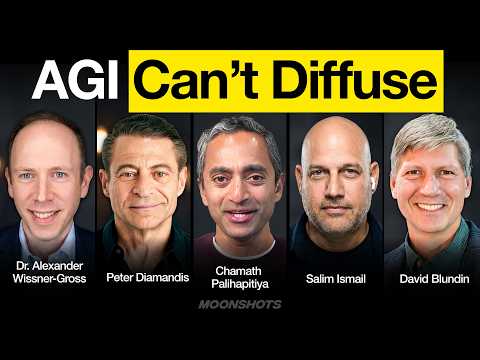 Chamath: Bitcoin Goes to Zero, Robots vs. $40T Debt...
 What Senior Engineers Are Actually Doing About AI...
 This Classic Steak Becomes Crazy Flavorful Tacos Wi...